SHEINBAUM SAYS U.S. MILITARY INTERVENTION RULED OUT AFTER TALK W/TRUMP
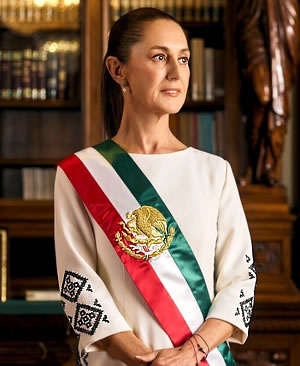
Mexican President Claudia Sheinbaum has firmly ruled out the prospects of any U.S. military intervention on her country's soil to Mexican combat drug cartels. She is stressing that any cooperation with Washington must be in respect of both Mexico’s sovereignty and its constitutional principles. Her stance follows a recent phone call with U.S. President Donald Trump, in which the two leaders discussed security and drug trafficking amid renewed talk in Washington of using force against cartel groups.
TRUMP'S THREATING REMARKS ARE REBUKED BY SHEINBAUM
U.S. President Donald Trump has repeatedly uttered the antagonistically taken idea of sending in U.S. forces against Mexican drug cartels within Mexico. Recently, he suggested that potential “land” strikes in Mexico are being considered after boasting of successes against maritime drug routes in Venezuela. He has additionally claimed that the drug cartels “run Mexico,” a rhetoric that has inflamed heated public debate in the streets and raised concerns in Mexico City on the possiblity of unilateral moves from the Trump administration. These comments gained urgency after a U.S. operation that removed Venezuelan leader Nicolás Maduro, which fueled speculation that similar cross‑border actions could be directed at Mexico or other countries in the region.
Against this backdrop, Sheinbaum requested to have a direct dialogue with Trump to clarify their country's repective positions and cool their increasing tensions.
SHEINBAUM'S 'NO' TO INTERVENTION & THE STRESSING OF SOVEREIGNTY WITH SHARED SECURITY
Following a roughly 15 minute call, Sheinbaum told reporters she had a “very good” and “friendly” conversation with Trump, but was very explicit in stating U.S. military action within Mexico is “not on the table.” Trump presented her an offer to send the U.S. military into Mexico if desired. Again, Sheinbaum rebuked the offer calling such assistance from the U.S. “not necessary.” She emphasized that Mexico’s constitution rejects such foreign military interventions with this specific legal framework guiding her government’s policy. Sheinbaum added that if future statements from Trump suggested otherwise, she would again immediately seek another call to explain Mexico’s positions. The Mexican president has framed her rejection of U.S. troops as a defense of sovereignty, not cartel violence. Sheinbaum has continually stressed that “cooperation (is a) yes."; (and) "intervention (is a) no.” pointing to ongoing collaborations of intelligence sharing, extraditions, and joint efforts to curb fentanyl and other synthetic drugs. Her main point was that Mexico is already taking much more aggressive actions against the cartels by bolstering military deployments to areas of high-profile trafficking. Her overall message was that meaningful bilateral results are achieved through coordinated law enforcement and judicial cooperation rather than foreign boots on Mexican soil.
At home, Sheinbaum’s categorical rejection of U.S. military involvement resonates with a long-standing Mexican consensus against foreign troops operating in the country. By underscoring constitutional limits and national pride, she seeks to pre‑empt opposition accusations that her administration might bend to pressure from Washington. For the bilateral relationship, her stance attempts to balance firmness and pragmatism: Mexico will continue to work closely with the United States on border security and drug trafficking, but only within a framework both governments publicly recognize as respectful of Mexico’s territorial integrity. In the current climate of hardline U.S. rhetoric on cartels, Sheinbaum’s clear “no” to intervention is meant to set the outer boundary of that cooperation.