
 0
0 1
1 2
2 3
3 4
420TH ANNIVERSARY OF LA GRAN MARCHA - THE LARGEST PROTEST IN U.S. HISTORY
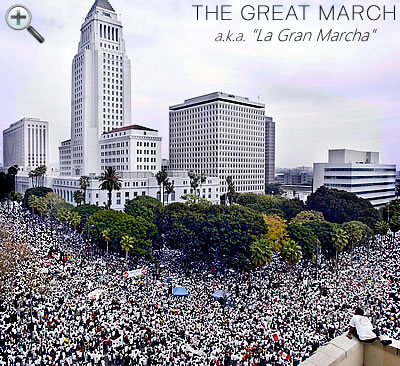
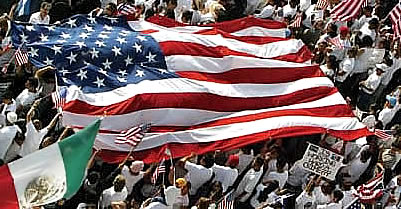
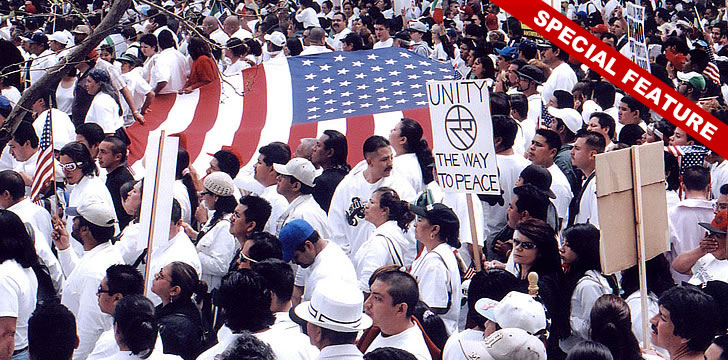
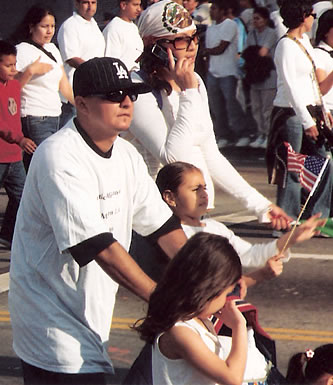
LOS ANGELES, CA - On March 25th, 2006, the largest single assembly of people ever gathered at any one spot at the same time in all of U.S. history occurred in the streets of downtown Los Angeles. It was known as La Gran Marcha, now also called "The Great March."
Massive Crowd Takes Over Downtown L.A. in Peaceful Protest
With a total crowd size estimated to be between 1.25 and 1.5 million demonstrators by three independent U.S. universities, this colossal protest was unlike any other seen in any major U.S. city before.
Beginning at 10:00 am on the corner of Olympic Blvd. and Broadway St., the crowd began to assemble for what was originally scheduled to be a straight ahead march up the Broadway Theater District to L.A. City Hall. That's what the city permit had allowed for and granted.
However, as the day progressed, it quickly became apparent that it would require much more than just one of the main thoroughfares in downtown to hold all of the marchers that would eventually come. As one of the organizers, Angel Tenez, stated in a CBS interview on the 10 year anniversary of the march: "When the Gran Marcha occurred, it was bigger than anyone's wildest dreams... This march went on for miles and miles, street after street, after street... Because, the people kept coming." ( ref. https://www.youtube.com/watch?v=JH7yu888ruk )
As the size of the demonstration swelled, the protestors spilled over and filled the main thoroughfare streets of downtown L.A., including: Spring St.; 1st St.; Main St.; Temple St.; and the immediate vicinity bridges over U.S. Highway 101. By mid-afternoon, the shouts of the massive crowd were so loud that many family members of protestors reported hearing its thunderous roar from many parts of town. Chief William Bratton who was then the head of LAPD ( and formerly the chief of NYPD too ) was quoted as saying, "I've never seen anything so large like this. What's most incredible is how peaceful it is." Remarkably, the LAPD didn't record one not even single arrest during the event.
What Was La Gran Marcha / "The Great March" All About? How Was It Organized & Who Attended the Demonstration?
The Great March of 2006 ( a.k.a. "La Gran Marcha" ) was a U.S. Latino community reaction to H.R.4437, a bill named the Border Protection, Antiterrorism, and Illegal Immigration Act of 2005. It was introduced during the 109th Congress by two House Republicans, Rep. Jim Sensenbrenner of Wisconsin and Rep. Peter King of New York. The bill was offically approved by the Republican controlled House of Representatives on December 16, 2005. HR 4437 was well on its way to being voted on by the Republican controlled Senate which had then been giving signs of following a path similar to the House. Although often perceived as quite sympathetic to immigrants, especially Mexicans, President George Bush Jr., also a Republican, was being pressured by his party to not veto the bill if it was to arrive on his desk.
Unquestionably, there were many disturbing elements of H.R.4437. However, the main point of contentention for all U.S. Latinos nationwide in addition to other ethnic immigrant communities was the threat that if passed, this bill would be breaking up many families. Despite the best efforts of our current president and his vilification of all non-white ethnic communities, being undocumented without the appropriate government papers of this country is still only a civil misdeamenor. It isn't a criminal felony offense as the current administration and his severly mistaken goonies like to claim. H.R.4437 would have made the misdeamor of living in the U.S. without proper paperwork a felony.
Prior to La Gran Marcha, with its maximum size reaching well over 1 million people ( est. by UT Austin in 2013; St. Mary's University in 2014; and SJSU in 2021 ); in actuality, it wasn't only Los Angeles that came out to stop H.R.4437. According to the Civil Rights and Labor History Consortium, University of Washingtton, there were over 400 protests against H.R.4437 which occurred in cities throughout the U.S. in the Spring of 2006. Chicago had the very first massive demonstration with a reported 300 thousand on March 10th. Dallas saw a reported 500 thousand, New York over 100 thousand, Phoenix 100 thousand, and Atlanta over 80 thousand on April 10th alone to name just a few.
The demographics of the crowds nationwide were overwhelmingly comprised of foreign born and native born U.S. Latinos. In Los Angeles, they were roughly 90-95% of the participants, with Mexican nationals, other Central Americans, and Mexican Americans being the majority. Alonside the Latino community, Asian Americans ( particularly of Korean descent ), black Caribbeans, and white liberals were also seen.
Why Do So Few People Know About La Gran Marcha? Why Hasn't It Received More Coverage in U.S. Mainstream Media?
Most Americans don't know much about TGM. As, it was shockingly ignored by most mainstream media outlets of the time. Simultaneously happening during March Madness, the national collegiate basketball series, it went either unreported or given 'very little' attention at all. Today, after an extensive photo analysis of the event by U.S. academics, it is now known to be the "largest single day and location protest demonstration in all of U.S. history." On March 25th of this week, it will be the 19 year anniversay of this unparalleled historic event.
Despite the very common practice of many in mainstream media, politics, and other circles who are tremendously quick to give crowd size estimates for public gatherings; the truth of the matter is, that, accurate crowd counts are nearly impossible to determine when any function is not a ticketed event. Under the scrutiny of three prestigious academic institutions ( i.e. Saint Mary's University, San Jose State University, and UT Austin ), it is now known to be a fact that the initially reported crowd size of 500 thousand participants by the Los Angeles Times on the morning after was glaringly incorrect. After an extensive photographic analysis, it has now been determined that between 1.3 and 1.5 million protestors assembled in the heart of downtown Los Angeles on this historic day. In comparison to any other event, it is now undoubtedly known that The Great March was the "largest single assembly" of people ever gathered "at any one place at the same time."
Key Points of The Border Protection, Antiterrorism & Illegal Immigration Act
The primary points of contention that provoked a need for massive protest demonstrations were the following five measures of this much despised bill:
1) HR 4437 would have immediately turned countles millions of undocumented immigrants from being misdemeanor fine offenders into hardcore criminal felons. A real life example of this would be the immigrant mother simply working as a housekeeper flipping sheets at the local motel could now charged as a felony criminal offender (instead of a misdemeanor fine only).
2) HR 4437 would have created laws to charge "any" person who knowingly aides an undocumented person to remain in the U.S. (without proper documentation "approved" and in good standing) to be guilty of criminal “smuggling.” This would have included anyone of the clergy, all nonprofit service sectors, and even medical professions.
3) HR 4437 would have required local law enforcement to act as federal immigration agents - which at the time, was both against the law and seen as unconstitutional. Donald Trump has subsequently requested this same action from local police as an executive level order.
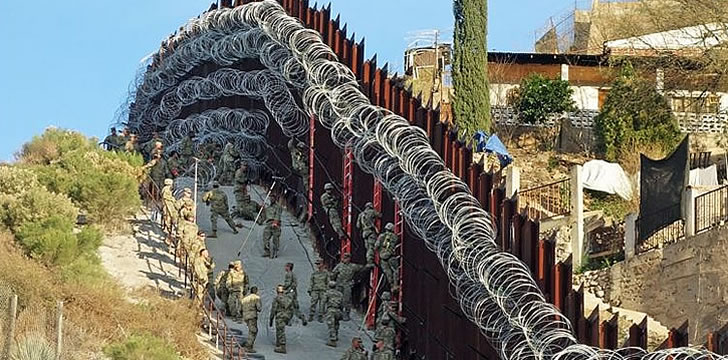
4) HR 4437 would have required the construction of a complete southern border barrier in the form of a wall and fence with Mexico, while leaving the northern border with Canada to remain virtually open. Donald Trump has continued this construction already started by others. In addition to the barrier wall, this bill would have also attempted to turn Native American reservations into immigrant detention centers.
5) HR 4437 would have required the creation of a new employment verification system "to be maintained by the Department of Homeland Security and comprised of data from the Social Security Administration" -- this also necessitated that every inhabitant of this country who would be seeking legal employment be required to carry a new type of social security card "made of a durable plastic" that "include an encrypted machine-readable electronic identification strip" or chip that "be issued to each individual (whether or not a U.S. citizen)."
In addition to these five main commonly mentioned statutes, there was another extreme provisions that is less commonly known. Law enforcement through Homeland Security was being given the authority to act solely "without judicial review." Not even Nazi Germany of the 1940s did that. Donald Trump however, has brought forth this unconstitutional practice.
This day should literally be included in the curriculum of every U.S. history classroom. The mass protests against H.R. 4437, marked a transformative moment in American immigration history. These demonstrations, which erupted across the United States in 2006, mobilized millions of people—Latinos, immigrants, and allies—who opposed the legislation’s harsh measures. The legislation sought to criminalize undocumented immigrants and those who provided them assistance. These protests not only defeated H.R. 4437 but also laid the groundwork for the resilience that helped thwart the sweeping deportation plans of President Donald Trump a decade later.
These demonstrations did more than block H.R. 4437—they galvanized a political awakening among immigrants and their allies. The movement fostered solidarity, advocacy networks, and a collective voice for immigrant rights. Latino voters became a crucial political constituency, and immigration reform emerged as a central issue in national politics. The defeat of H.R. 4437 also sent a clear message to lawmakers: harsh anti-immigrant measures would provoke widespread resistance.
The protests against H.R. 4437 were a pivotal moment that reshaped the trajectory of immigration activism in the United States. Through unity and resilience, the legacy of 2006 continues to shape the fight for immigrant justice in America.